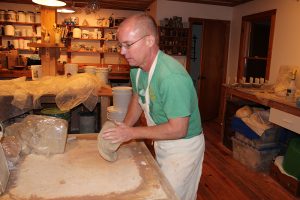
Doug took his first pottery class while working as a Software Developer after moving to the Triangle area from Florida. And that was when his obsession with clay began. Starting with selling pottery at street fairs, he moved on to rent a pottery studio space from one of his teachers in Durham. Then, after a two month long Penland School of Crafts class, he knew it was time to build his own studio in Chatham County. That was in 2002.

Functional pottery is the source of endless fascination for Doug. “I love using handmade pottery in my house and sharing that with other people. I make sure that the glazes and shapes are made for hard work. I run pots that I make through the gauntlet of kids and dishwashers to make sure they can withstand daily use.”

“I use stoneware. I’m a sucker for a humble little brown pot. It leaves the space for what it’s going to contain. A simple plate pairs with the food better and can be easier to live with. I have an earthy sensibility and I like the pottery that’s a little quiet but has personality.” Doug makes all his own glazes, some based on well known glaze recipes, others that he has developed over the years.

Like many artists, Doug is inspired by shapes in nature, especially rocks and trees. “There’s a very solid and sturdy aspect to our mature forest. I want sturdy and substantial pots. I don’t make thin and ‘precious’ things. They’re more substantial, earthy and I like that. Durability is important to me. It’s almost a mission. The glazes I use– I run them through the dishwasher every day and it’s important to me that they stand up to a lot of use.”

During the firing process, he sprays in sodium carbonate as a final layer of glaze that’s applied in a 65% random way. “I use a garden sprayer with a couple gallons of sodium carbonate and water and spray into the kiln starting at cone 6. I spray and cut back the oxygen and that affects color and surface in ways that are both predictable and unpredictable.”

Unlike many potters, Doug uses a treadle wheel – a handmade, wooden pottery wheel with a lightweight fly wheel. “They are very good at moving slowly with lots of control. Using this kind of wheel helps me leave nice marks from the throwing process that bear the evidence of process for all stages of my pottery making process.”
The aesthetics of valuable imperfection from Japanese influence lends itself to featuring natural processes and marks from the hand in the work. See more of Doug’s pottery pieces on his Chatham Artists Guild gallery page.