• Skip to main content
  • Skip to footer

Chatham Artists Guild

chatham artists guild

2025 Chatham Artists Guild Studio Tour

  • About
    • About the Guild
    • Board of Directors
    • Donate
  • Artists
    • Our Artists
    • Artist Stories
    • Member Login
    • Your Account
    • Join
  • News
    • Recent Updates
    • Subscribe
  • Join
    • Apply for Membership
    • Returning Members
  • Membership
    • New Member Orientation
    • Your Artist Profile
    • Pay Your 2025 Studio Tour Fees
    • 2025 Studio Tour Brochure Information Form
    • Returning Members
    • Your Orders
    • Member Resources
  • Studio Tour
    • 2025 Studio Tour
    • Tour Updates
  • Events
  • Sponsors
  • Education
    • Emerging Artists Program

Search Chatham Artists Guild

Subscribe to Chatham Artists Guild News!

Bi-Monthly Newsletter • Studio Tour Updates • Special Events

  • This field is for validation purposes and should be left unchanged.

Ellison Goodwin

November 1, 2021

Previous ArtistView Our ArtistsNext Artist

Intuitive Form Ceramics

Media: Ceramics, Sculpture
Website: intuitiveform.com
Email: ellison.goodwin@icloud.com
Phone: (919) 998-9662

Social Media

Facebook: facebook.com/artbyellison
Twitter: twitter.com/ellison_goodwin
Instagram: instagram.com/intuitive.form.ceramics

My natural process is to sculpt intuitively.

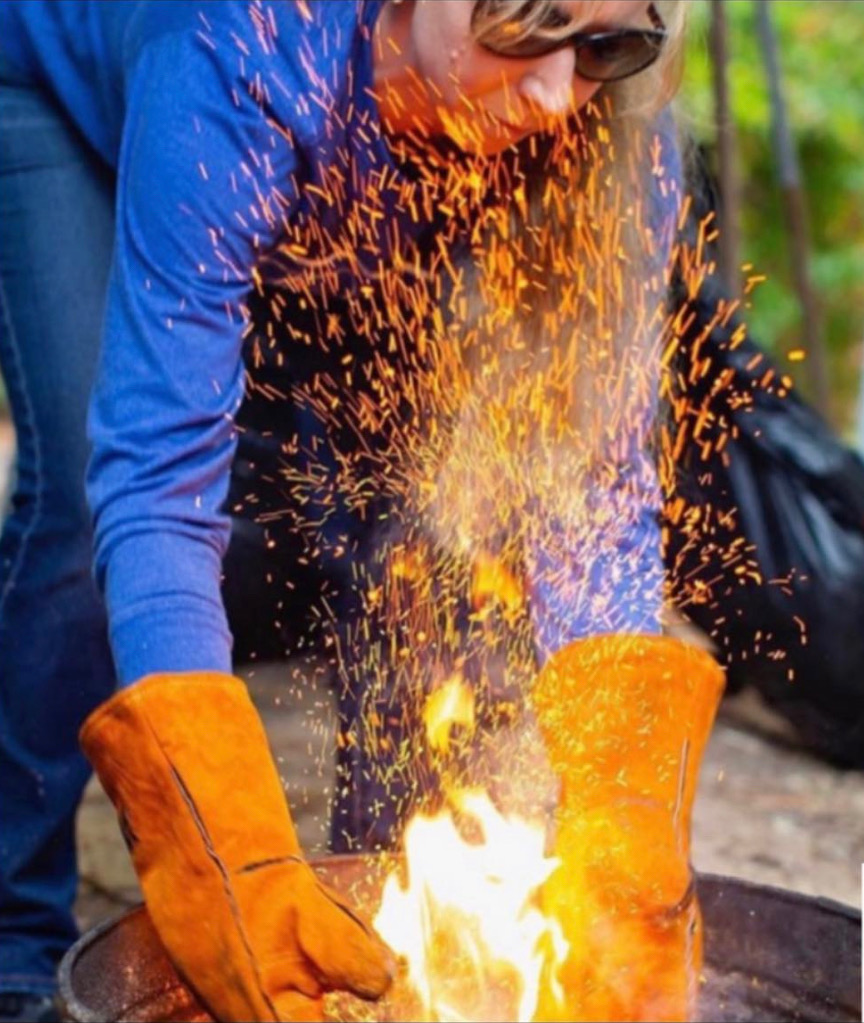
Since my formal training, my ceramic practice has been focused primarily on exploring two distinct alternative firing processes outside of the electric kiln. I’m a bit of a”firebug” alternating between using wood kilns and also the raku process (gas kiln and igniting combustibles like sawdust or paper shreds to cause reactive glazes to respond to the flames).

When I am sculpting, the work becomes a stream of consciousness between myself and the materials. My seasoned awareness of fundamental elements of design such as balance, positive and negative space, form and surface inform my process. My color choices are loosely inspired by elements of the color theory of Josef Albers (1888-1976). Once I construct a traditional pinch pot form I create a geometric line drawing around the lip of the pot which I then carve into a three-dimensional element.

The evolution of each piece’s design represents the historical evolution of a primitive form of pot making, the pinch pot, into a contemporary sculpture relevant to the modern era with influences of mid-twentieth century architecture and graphic design. I particularly enjoy the juxtaposition of the sharp geometric subtractive carving to the additive nature of the organic spherical form of the pinch pot body. My artwork represents a bridge between the idea of ceramic pots as utilitarian craft-made objects and ceramic sculptural pots as modern formal art pieces. My pieces invoke a ceramic origin story through technique while presenting aesthetics of contemporary design.

Many artists may shy away from divulging where in their process they find themselves intimidated, but I have learned  to allow myself to let the previous stage of each piece inform my next design choice. I do not plan a pot from start to finish ahead of time, hence my attachment to the concept of “intuitive form.” Perhaps the most daunting stage of design for me is glazing my sculptures. I either raku fire or wood fire my work to finish it. I feel that these atmospheric methods of firing return each work to the primitive space from which it originated and allows me to glaze in a way that feels as intuitive as my carving process. When I am planning the application of color to the surface of a bisque fired sculpture, it is only a bare, uniform shade of light-cream colored clay. My Raku pieces have bold colors contrasted with sections of white crackle glaze and rich matte black sections. My wood fired pieces highlight the flow of the flame and simultaneously capture the falling ash of the kiln atmosphere as permanent evidence of a fire that once was.

I believe that my attraction to the concept and action of capturing evidence of the atmosphere in which a pot has been fired can be likened to my exploration of myself and the effects that various environments of my life have had upon my person as I exist today. There is a push – pull dynamic in the design elements of my work that suggests the sense of cause and effect that is a universal experience of humanity. I suppose I find some resolution of conflicting energies by creating a semblance of balance between all of the design elements as I complete each piece.

Gallery
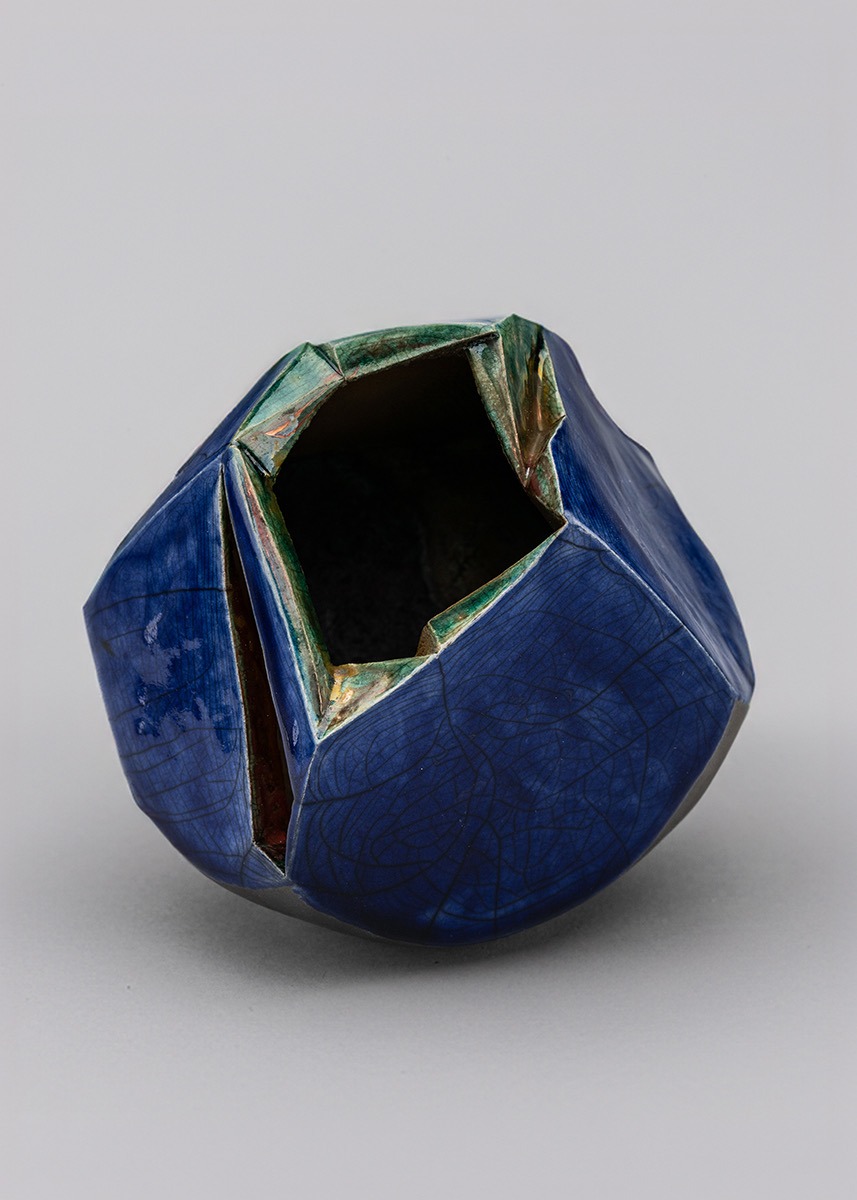
Ceramic hand built pinched pot with angular carved lip. After the carving and the first firing is completed, I use a pencil to mark out the areas where the raku glazes will be applied. When applying the colors to this pot I created a visual effect inspired by the illusion of a ribbon as it is twisted and seems to suddenly narrow in width at the twist. This surface design is intended to pull the eye of the viewer around the exterior of the pot, over the lip of the pot, and into the inside of it in a continual fluid motion.
Ceramic hand built pinched pot with sculpted and carved lip. The surface design of this pot has areas of bare clay, turning matte black during firing. There are white, yellow, and lobster colored crackle raku glazes are also applied. A varied degree of crackle sizes can be seen in the white glaze as a result of exposing the surface of the hot pot and re-covering it at the end of the raku process changing the degree of which the cracks occur.
Ceramic, hand built pinched pot with sculpted and carved lip. This pot has an iridescent surface resulting from a fuming technique achieved in the over 2000 degree atmosphere of a wood kiln. By placing a bowl of stannous chloride beside this pot in the wood kiln and the bare surface of the piece gets coated in the fumes of stannous chloride when it vaporizes during the firing of the kiln. There is an iridescent sheen to the surface of this work when it is moved around as light passes over the angles of the carvings.
Ceramic hand built pinched pot with sculpted and carved lip. On this pot I applied a surface treatment of white and blue crackle raku glazes. I also left sections of the clay surface bare of any surface treatment. Bare surfaces become a rich matte black as a result of saturating the air around the pot with smoke allowing the bare clay to trap carbon in the un-glazed areas. Black crackle patterns in the glazed areas are a hallmark of the raku firing technique. As mentioned, this pot is fired using a gas kiln and by implementing raku techniques to finish the firing process. I make the raku glazes myself from raw materials.
Wood fired pinch pot

About Ellison Goodwin

Note: Artists are responsible for the content on their own profile pages.
If you have a concern about the content on an artist profile, please contact us.

Footer

Contact Us

Chatham Artists Guild
PO Box 1024
Pittsboro, NC 27312
chathamartists@gmail.com

Let’s Connect

  • Email
  • Facebook
  • Instagram
  • Pinterest
Subscribe to Our Newsletter Donate to the Guild

Copyright © 2025 · Chatham Artists Guild · All Rights Reserved · Website by Tomatillo Design